
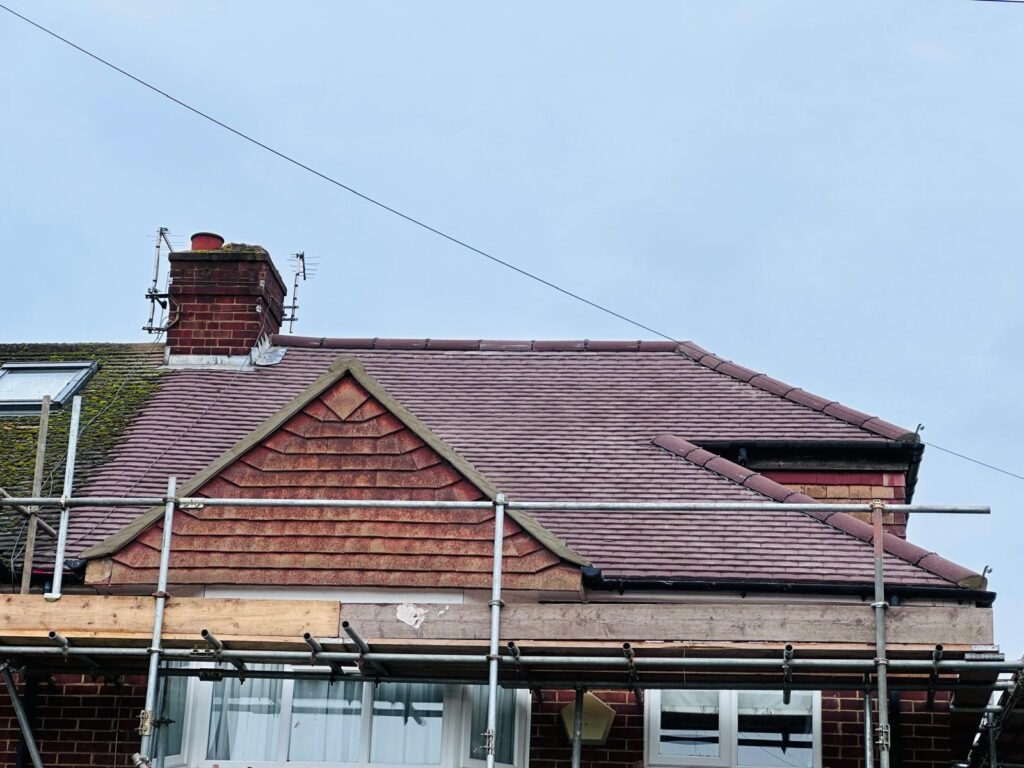
Quick answer: If your roof is leaking in heavy rain, catch the water in a bucket, move belongings, switch off any nearby electrical circuit and keep away from a sagging ceiling. Don’t go on the roof. Then call a roofer who answers 24/7. Most heavy-rain leaks come from blocked gutters or valleys, slipped tiles, worn flashing or tired flat roofs.
★ 5.0 · 20 Google reviews24/7 call-outsFree written quotesAll work guaranteed
Key takeaways
- First, contain the water and make electrics safe; your safety comes before the house.
- Also, never climb onto a wet or windy roof, and keep away from a sagging ceiling.
- Most heavy-rain leaks start at gutters, valleys, slipped tiles, flashing or flat roof joints.
- Insurers often only cover sudden storm damage, so take photos and keep every receipt.
- Finally, a leak that is left can cause damp and mould, which can affect your health.
In this guide
- Roof leaking in heavy rain: what to do in the first 30 minutes
- Is it an emergency?
- Why a roof leaks in heavy rain but not in light rain
- What a roofer will do about a roof leaking in heavy rain
- How much does it cost?
- Insurance: what to do before you claim
- How to stop it happening again this winter
- Frequently asked questions
Roof leaking in heavy rain: what to do in the first 30 minutes
- Catch the water. Put a bucket, bowl or storage box under the drip, then lay towels around it so splashes don’t soak the floor.
- Move what matters. Next, carry electronics, rugs, documents and furniture out of the way, or cover them with plastic sheets.
- Make electrics safe. If water is near a light fitting, socket or appliance, switch off that circuit at the fuse box. Don’t touch wet switches.
- Keep away from a sagging ceiling. A ceiling bulging with water can come down, so keep everyone, especially children and pets, out from under it.
- Check the loft, if it is safe. Then, with a torch, look for where water is running in, and put a tub under it to take the pressure off the ceiling.
- Stay off the roof. Wet tiles, wind and old gutters make it dangerous, so never climb up yourself.
- Take photos and call a roofer. Finally, photograph the damage inside and out for your insurer, then call a roofer who answers 24/7.
Should you pierce a bulging ceiling?
You may read online that you should pierce a bulging ceiling to let the water out. We don’t recommend it, because wet plaster can fall and water may be near wiring. So keep clear, switch off that circuit and let a professional deal with it.
London weather right now (November 2026)
The Met Office November outlook, reported by LBC (2 November 2026) said early November should be mostly dry and windier in the south, then turn more unsettled in the second half of the month, with the wettest and windiest weather possibly reaching southern parts. Storms Austen and Boelo have already been named this season, and the next name is Chloe (UK storm names tracker). So now is the time to get loose tiles, blocked gutters and tired flat roofs sorted.
Is it an emergency?
| What you see | How urgent | What to do |
|---|---|---|
| Water dripping steadily or pouring through the ceiling | Emergency | Contain it, make electrics safe and call now |
| Ceiling bulging or cracking | Emergency | Keep everyone away, switch off that circuit and call now |
| Water near lights, sockets or the fuse box | Emergency | Switch off at the fuse box and call now |
| Small damp patch that grows only in heavy rain | Urgent | Book a roofer within a few days |
| Old brown stain, dry and not spreading | Not urgent | Book an inspection, because the cause may still be there |
If it is an emergency, see our 24/7 emergency roof repairs page or call us any time.
Why a roof leaks in heavy rain but not in light rain
A roof that seems fine in a shower can still leak in a downpour, because heavy rain finds weaknesses that light rain never reaches. In London homes, these are the usual culprits:
- Blocked gutters and valleys. Leaves and moss stop water draining, so it backs up under the tiles or over the wall.
- Hidden valley gutters. Many Victorian terraces have a V-shaped valley between two slopes. When its outlet blocks, water floods into the top-floor ceiling.
- Slipped or cracked tiles and slates. Wind drives rain sideways through the gap, especially near ridges and verges.
- Worn flashing. Lead or mortar around chimneys, walls and rooflights cracks, so water runs down inside.
- Flat roof extensions. Old felt splits or ponds, and joints at the wall open up under the weight of water.
- Torn felt under the tiles. On older roofs, the underlay perishes near the gutter, so driven rain gets into the loft.
What a roofer will do about a roof leaking in heavy rain
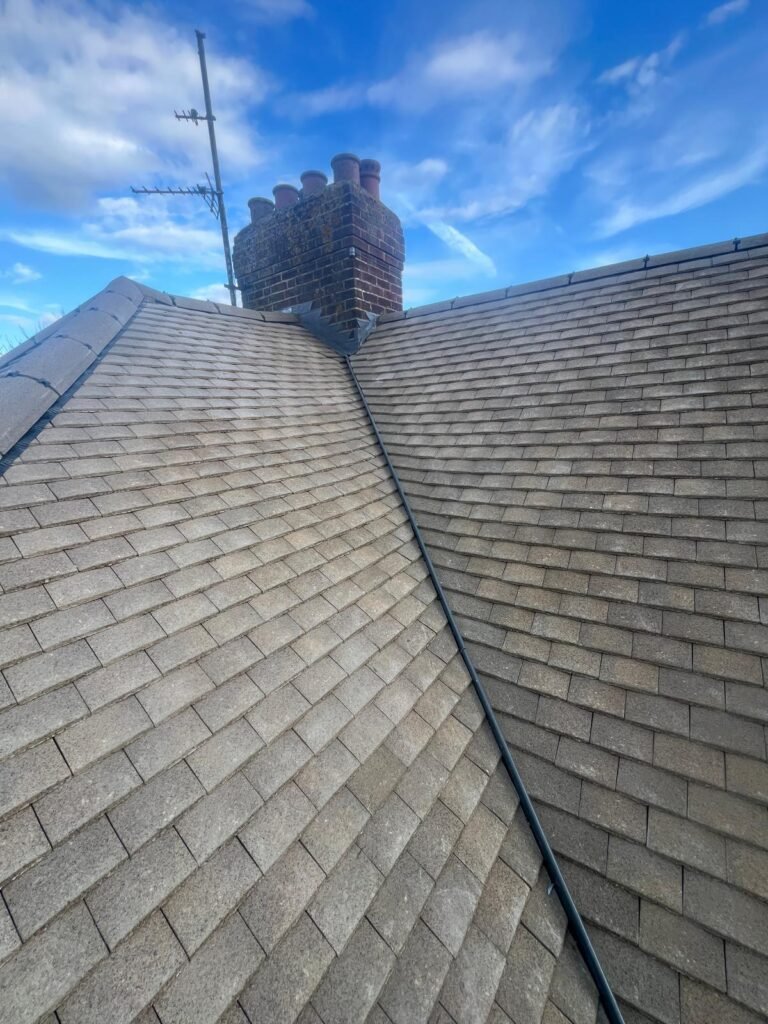
A good roofer has two jobs. First, stop the water getting in. Second, find the real cause and fix it properly. So on the night, that often means:
| Cause | Making it safe | Permanent fix |
|---|---|---|
| Blocked gutter or valley | Clear it so water can flow | Repair the gutter or reline the valley |
| Slipped or missing tiles | Refix, or else cover the gap temporarily | Matching replacement tiles or slates |
| Worn flashing at a chimney | Seal or sheet the area | Repoint, then new lead flashing |
| Split flat roof | Patch or sheet the split | Repair, or else a new EPDM or GRP roof |
Also, the permanent repair often needs a dry day, especially for mortar or flat roof work. We photograph what we find, so you can see the cause for yourself.
How much does it cost?
Checkatrade’s leaking roof guide (updated February 2026) puts a typical emergency call-out at around £350, while MyBuilder’s 2026 roofer price guide puts small repairs at £150 to £500. Night-time, weekend and high-access jobs usually cost more, mainly because of time and safety equipment.
| Job | Typical 2026 price | Source |
|---|---|---|
| Emergency call-out | Around £350 | Checkatrade |
| Small repair (leak, a few tiles) | £150 to £500 | MyBuilder |
| Standard scaffolding, if needed | About £900 per week | Checkatrade |
| Flat roof replacement (GRP or EPDM) | £3,000 to £6,000 | MyBuilder |
We don’t charge a call-out fee to inspect, and the permanent repair is quoted in writing before we start.
Insurance: what to do before you claim
According to Which? (November 2025), many insurers use the ABI definition of a storm, which includes gusts of at least 55mph or rain of at least 25mm an hour. Wear and tear, such as an old roof that hasn’t been maintained, is often excluded. So:
- Photograph the damage before anything is moved or repaired.
- Call your insurer early, because most have a 24-hour line.
- If you arrange emergency repairs yourself, tell the insurer and keep every receipt.
- Keep the roofer’s written report and photos.
- If a claim is handled unfairly, complain first, then you can go to the free Financial Ombudsman Service.
How to stop it happening again this winter
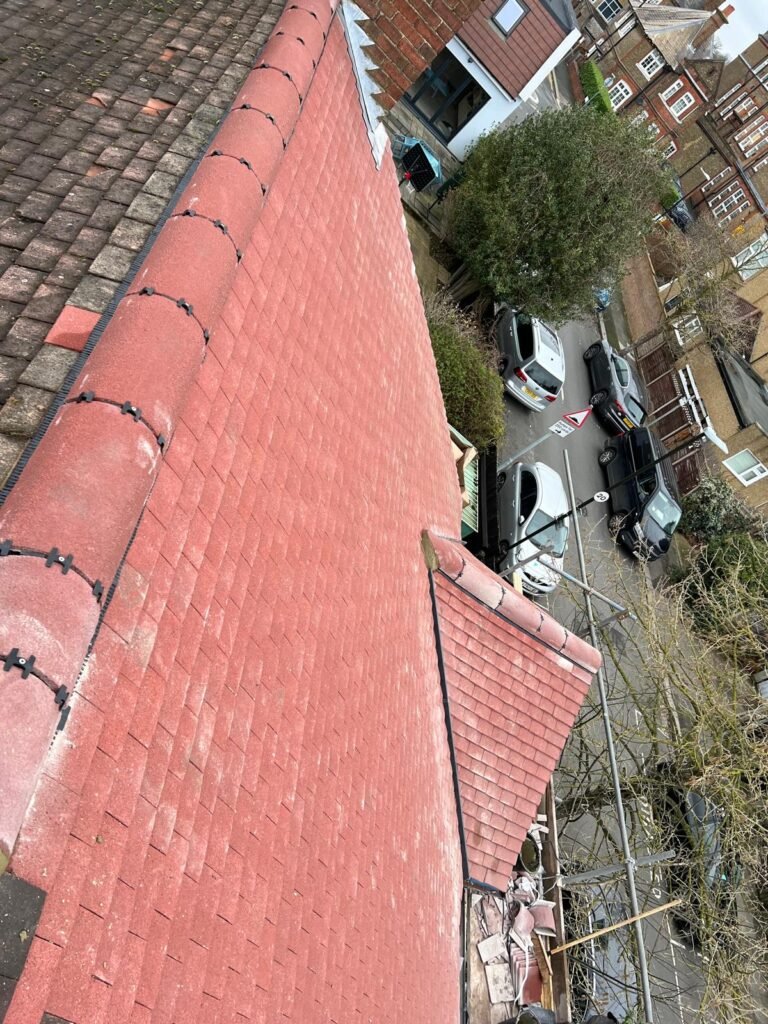
- Clear gutters and downpipes after the leaves fall, and again in early spring.
- Look at the roof from the ground with binoculars for slipped tiles or gaps.
- Check chimney flashing and mortar for cracks.
- Look in the loft after heavy rain for daylight, damp timber or wet insulation.
- Replace tired felt flat roofs before winter rather than patching them again.
Also, UK government damp and mould guidance lists defective roofs and blocked gutters among the main causes of damp and mould. So fixing a leak quickly protects your health, not just your ceiling. See our winter roof maintenance checklist for more.
What our customers say
We’ve completed more than 100 roofs across West London, and we’re rated 5.0 from 20 Google reviews. A couple of things customers have written:
“M K and Sons Roofing were brilliant. Friendly team, honest quote, and the roof looks proper tidy now.”
Google review
“No hidden fees or unexpected costs. Honest service.”
Google review
You can also read all of them on our Google profile.
Why call M.K & Sons when your roof is leaking in heavy rain?
- Local: we’re based in Hayes and cover West London, including Ealing, Southall, Uxbridge and Hounslow.
- Our own team: the people who quote are the people who do the work.
- Fully insured, with a written guarantee on our work.
- Free written quotes and no call-out fee, so you know the price before we start.
- 24/7 phone line for leaks and storm damage.
Roof leaking in heavy rain right now?
Call or WhatsApp M.K & Sons Roofing any time, day or night. We’ll make the roof safe first, then quote in writing for the permanent repair.
Frequently asked questions
What should I do if my roof is leaking in heavy rain?
First, put a bucket under the drip and move belongings away. Then switch off any electrical circuit near the water at the fuse box, and keep people out from under a sagging ceiling. Stay off the roof, take photos for your insurer and call a roofer who answers 24/7.
Why does my roof only leak in heavy rain?
Usually because a small weakness only lets water in when there is a lot of it. Blocked gutters and valleys overflow, wind drives rain under slipped tiles, and worn flashing or flat roof joints give way under volume. So a roof that seems fine in light rain can still be failing.
Should I make a hole in a bulging ceiling?
We don’t recommend it. Some online advice says to pierce a bulging ceiling, but water near light fittings and falling wet plaster are real risks. Instead, keep everyone away from under it, switch off that circuit and call for help. If it is close to falling, leave the room.
Will my home insurance cover a leaking roof?
It depends on the cause. Many policies cover sudden storm damage, often using a definition of gusts of at least 55mph or rain of at least 25mm an hour, according to Which?. Wear and tear is usually excluded, so take photos, keep receipts and call your insurer quickly.
How much does it cost to fix a roof that leaks in heavy rain?
Checkatrade’s February 2026 guide puts a typical emergency call-out at around £350, and MyBuilder’s 2026 guide puts small repairs at £150 to £500. Valleys, chimneys and flat roofs can cost more. We don’t charge a call-out fee to inspect, and we quote in writing.
Can a leaking roof cause mould?
Yes. UK government guidance lists defective roofs and blocked gutters among the main causes of damp and mould, which mainly affect the airways and lungs. Children, older people and anyone with asthma or a weak immune system are most at risk, so dry the area and fix the leak quickly.
Sources: Checkatrade’s leaking roof guide (updated February 2026); MyBuilder’s 2026 roofer price guide; Checkatrade’s roof installation cost guide (updated June 2026); Which? (November 2025); UK government damp and mould guidance; Met Office November outlook, reported by LBC (2 November 2026); UK storm names tracker. Checked in November 2026.
Pingback: Emergency Roof Repairs Walthamstow E17 | 24/7 | M.K & Sons
Pingback: Emergency Roof Repairs Barnet EN5 | 24/7 | M.K & Sons
Pingback: Emergency Roof Repairs Bromley | 24/7 | M.K & Sons